Hired by an Algorithm
AI is no longer a feature bolt-on for recruiting teams — it is rapidly becoming the operating system underneath talent acquisition itself. Here is what that actually means for organisations, candidates, and the people stuck in the middle.

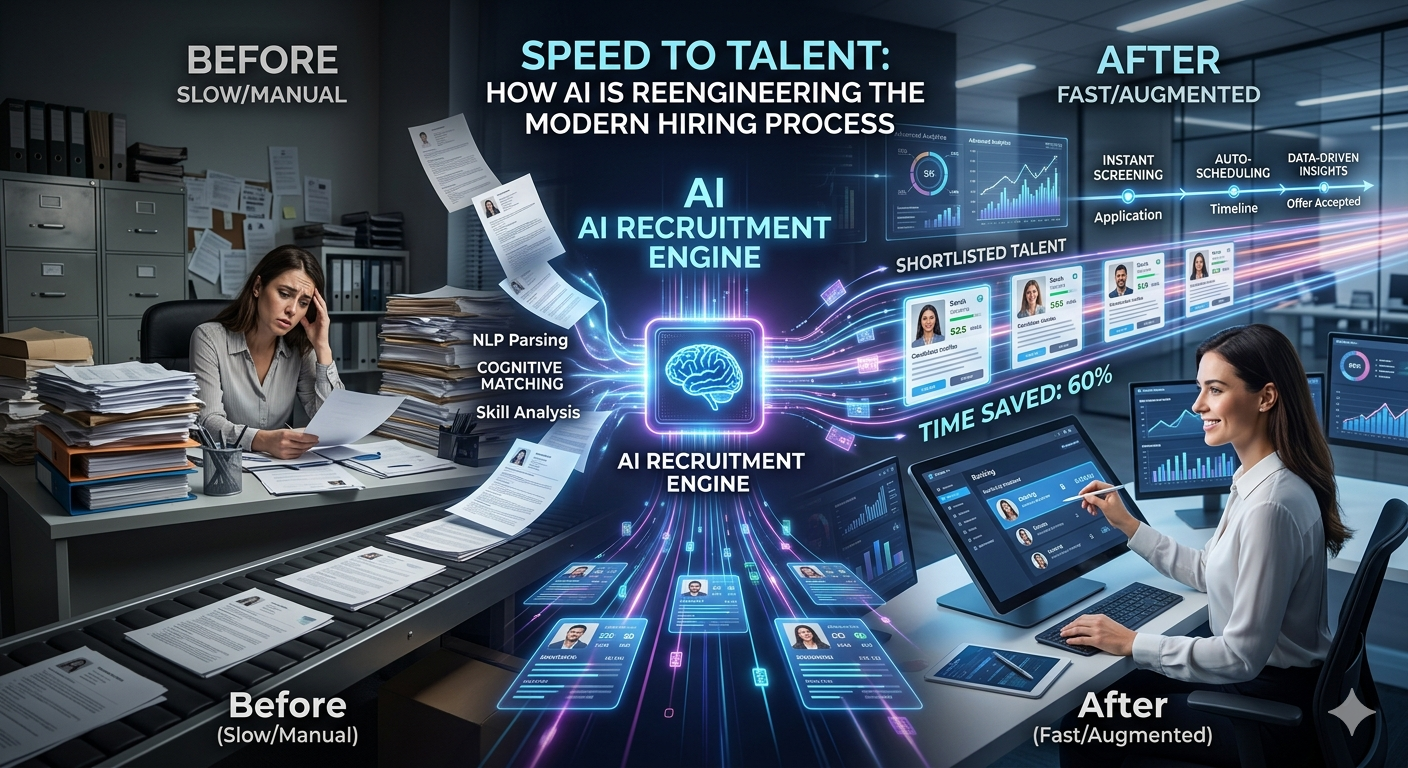
A hiring manager at a mid-sized logistics company recently described her Tuesday morning routine: she opens a dashboard, reviews twelve ranked candidates for a regional ops role, picks four for first-round interviews, and closes the tab. The sourcing, screening, outreach, and scheduling all happened overnight. She touched none of it. What used to consume two weeks of her team's time now takes eleven minutes of hers.
This is not a futurist scenario. It is already the operational reality for a growing number of talent acquisition teams in 2026 — and the shift is only accelerating.
$39B global digital talent acquisition market in 2026, up from $36B in 2025
84%of talent leaders worldwide say they will use AI in hiring this year
2.3×increase in AI literacy skill-building among TA professionals year-on-year
The operating system underneath hiring
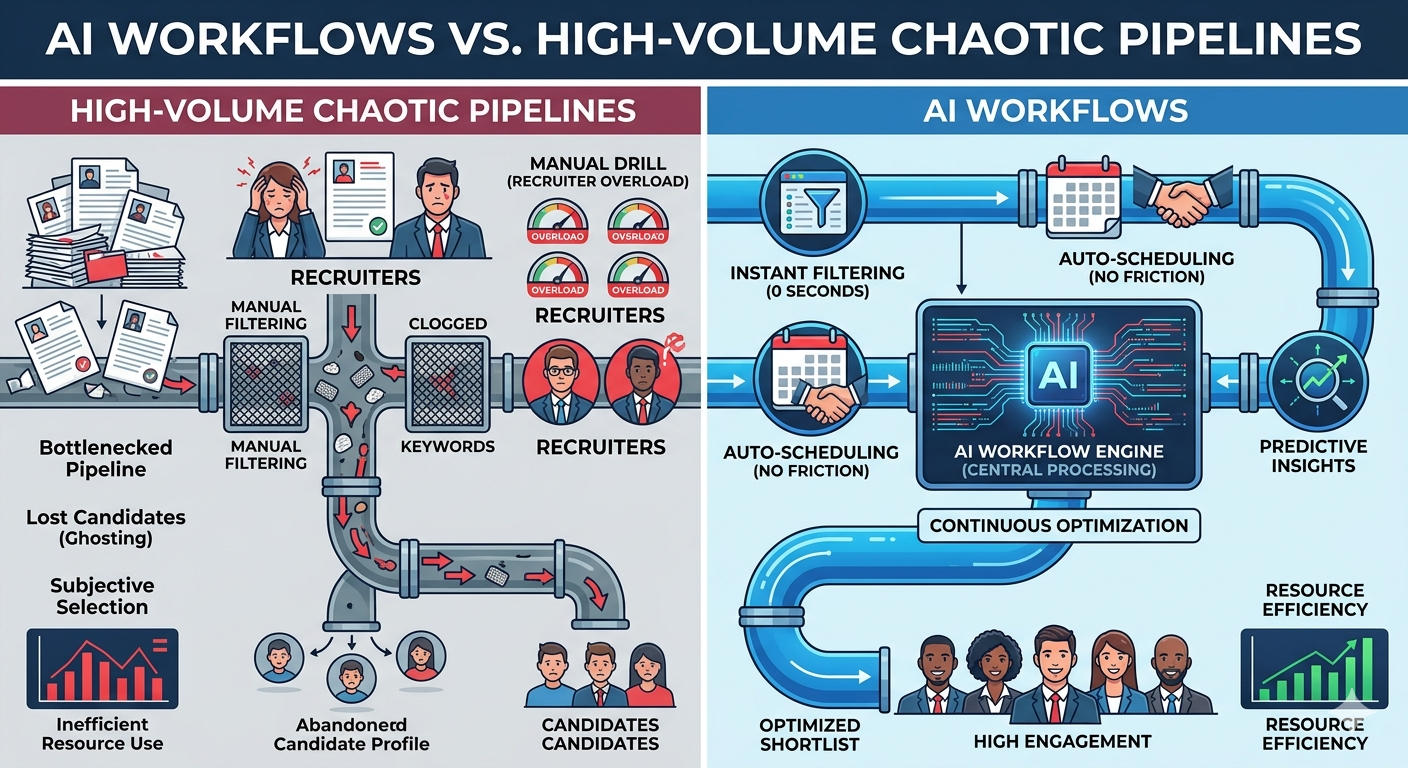
For years, AI in talent acquisition meant one thing: CV screening. Feed the model a job description, let it filter thousands of applications, hand the results to a human. Useful, yes — but fundamentally still a bolt-on layer sitting above a traditional process.
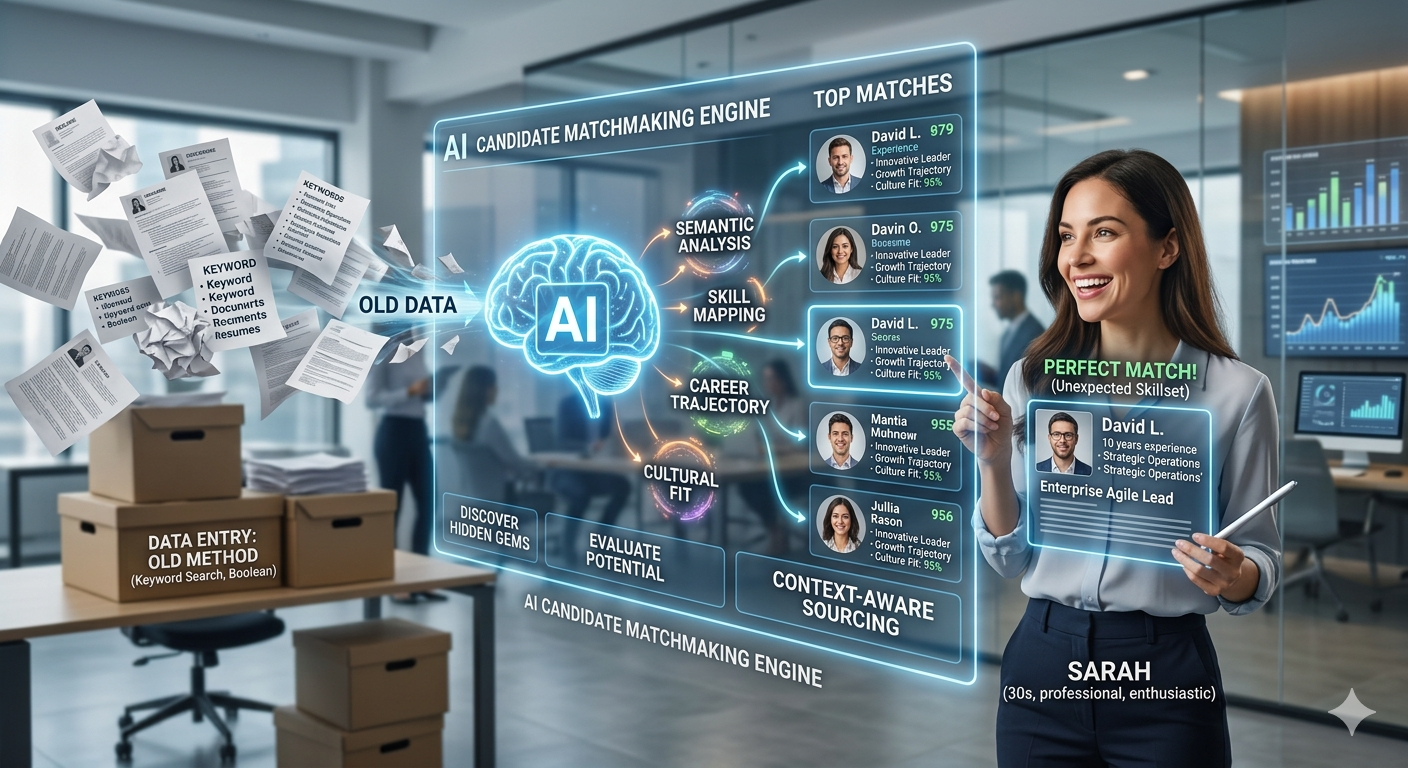
What is happening in 2026 is categorically different. Agentic AI systems — models that plan, act, and iterate without human prompts — are assuming end-to-end ownership of entire hiring workflows. They do not wait to be told what to do next. They identify a vacancy, build a sourcing strategy, reach out to passive candidates, schedule conversations, gather interview intelligence, and surface a ranked shortlist. The recruiter steps in at the judgment moments: the offer negotiation, the candidate who seems right on paper but wrong in conversation, the hiring manager whose real requirements are not what the job description says.
"Enthusiasm for AI dramatically outpaces readiness to implement it. Ninety-three percent of Fortune 500 CHROs have started integrating AI tools — yet most lack the governance structures needed to succeed."
Horton International, 2026 TA Trends Report
Where AI is actually adding value across the funnel
AI impact by hiring stage — adoption and value delivery
Sourcing
92%Highest AI maturity
Screening
85%Skills over CVs
Scheduling
80%Biggest time saving
Candidate comms
70%Personalised at scale
Interview insight
52%Rapidly maturing
Offer & close
22%Human territory
The skills revolution inside TA itself
There is a quiet irony running through 2026's talent acquisition story: the function that is deploying AI most aggressively is also the one most acutely feeling the skills gap it creates. Gartner projects that by 2027, 75% of hiring processes will include assessments of workplace AI proficiency — meaning recruiters will soon be screening candidates for the same capability they are scrambling to develop themselves.
The role of the recruiter is being renegotiated in real time. Administrative work — the interview scheduling that consumed 38% of a typical recruiter's week — is largely gone. What remains, and what is being elevated, is the work that was always too important to do properly: deep candidate conversations, hiring manager counsel, workforce planning, employer brand stewardship. The best TA teams are repositioning this as a feature, not a threat.
What AI now owns
Market mapping and talent pool identification
Multi-channel outreach and follow-up sequencing
Interview scheduling and logistics
Application status updates and candidate comms
First-pass skills assessment and ranking
What humans still own
Reading culture fit and leadership potential
Navigating candidate hesitation and counteroffers
Advising hiring managers on realistic expectations
Employer brand relationships and community-building
Governing and auditing AI outputs for bias
The regulation clock is ticking
Not everything about this shift is smooth. The EU AI Act's compliance deadlines for hiring systems arrived in August 2026, requiring organisations operating in Europe to demonstrate explainability for any AI-assisted hiring decision. That means knowing — and being able to articulate — why the algorithm ranked candidate A above candidate B. Many companies deploying off-the-shelf AI recruiting tools discovered, uncomfortably late, that their vendors could not answer that question.
Privacy governance is the other pressure point. Talent intelligence platforms now analyse social media behaviour, professional network activity, and inferred career intent signals. The candidate who does not know they are being assessed has become a live ethical and legal question, not just a philosophical one. The organisations navigating this best are those that built their AI governance frameworks before they needed them — not in response to a regulator's letter.
Quality over volume — the metric that changes everything
Perhaps the most significant cultural shift AI is driving in talent acquisition is the death of the volume mindset. For decades, success in recruiting was measured in pipeline size: how many applications, how many interviews, how many offers. AI makes volume trivially easy to generate — and therefore worthless as a signal of function health.
The metric that matters now is quality-of-hire: how does this person actually perform six months in? Twelve months in? AI is beginning to close the feedback loop between hiring decisions and performance outcomes, giving TA teams data they have never had before. That data is already reshaping how organisations define a good recruiter. It is less about how fast you fill roles and more about how well the people you place actually stick and succeed.
The bottom line
AI has not automated talent acquisition — it has split it cleanly in two. Everything that was transactional, repetitive, and schedulable now belongs to the machine. Everything that requires judgment, empathy, and genuine human insight belongs, more clearly than ever, to the recruiter. The organisations that understand this distinction — and invest accordingly in both — are building a hiring capability that is genuinely hard to replicate. The ones still treating AI as a screening tool are already falling behind.